Bass John Hobbs guides us through the wild world of ever-changing beats, and makes a timely mention of The Apprentice as a new series begins.
Do you like a whirling waltz, a merry minuet or a stately sarabande, or would you prefer a military march, a torrid tango or a perky polka or do you like them all?
Maybe something more irregular would be the right thing to put a spring in your step, or would that be a mission impossible?
Welcome to the world of Time Signatures!
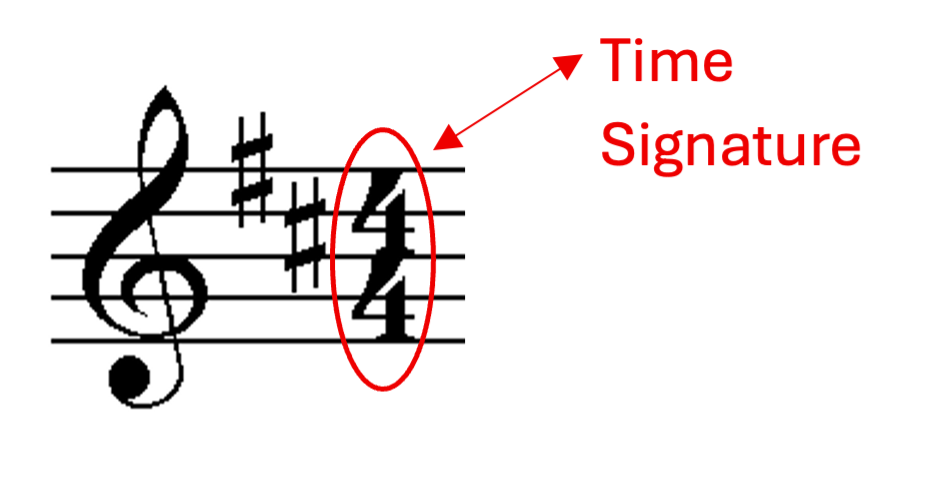
Time signatures tell us the pattern of stronger and weaker beats, accents or stresses to expect in a piece of music. If you walk to the pulse or beat of a piece in 2 or 4 time, the stronger beat is always on the same foot, for example, ‘Land of hope and glory’, ‘Ode to joy’ and Prokofiev’s ‘Dance of the Knights’ (signature tune to BBC’s The Apprentice).
Not so in 3 time where the stronger first beat will be on the left foot in one bar but right in the next. Examples include ‘Edelweiss’, ‘Moon River’, ‘Happy Birthday to you’, and less obviously ‘Jerusalem’ and ‘Bolero’.
But let’s explore the world of more unusual time signatures. Though often called ‘irregular’, that’s perhaps not the best name because they do have a regular pattern, just not regular 2, 3 or 4 time.
In last December’s Christmas is Coming concert, the massed choirs of Music for Everyone sang John Rutter’s 5/8 arrangement of the Donkey Carol, and Nottingham Chambers Singers performed a piece in 7/4, Noel by Gordon Thornett.
Years ago, I learned from textbooks that Mars, the bringer of war, from Holst’s Planets, which dates from 1914-1916, was in 5/4. However, Tchaikovsky beat him to it with the 2nd movement of his 6th Symphony in 1893. A completely different mood but still in 5/4. Earlier still, in 1874, Mussorgsky begins his promenade around the exhibition with pairs of 5/4 and 6/4 bars.
Fast forward to 1959 and the release of the punningly titled Dave Brubeck album ‘Time Out’, featuring Paul Desmond’s ‘Take Five’ and the ‘Blue Rondo à la Turk’. The latter is in 9/8 but the grouping of notes makes clear that the 9 is made up of 2+2+2+3 grouped into 4 ‘beats’ with last one longer. His ‘Unsquare Dance’ is heard regularly on TV as background music. It’s a great exercise to join in the clapping on beats 2,4,6 & 7 in the 2+2+3 pattern.
For another 7/4 try the allegro from first movement of Bernstein’s Chichester Psalms (1965). This comes after the slow introduction where the time signature changes almost every bar. The fast 7/4 feels like 3 in a bar with a longer 3rd beat, so a 2+2+3. The Beatles ‘All you need is love’ also features bars of 4/4 and 3/4 paired together.
Here’s a quote from the score to Derek Bourgeois’ Serenade, composed for his own wedding:
“Not wishing to allow them the luxury of proceeding in an orderly 2/4, the composer wrote the work in 11/8, and in case anyone felt too comfortable, he changed it to 13/8 in the middle! “
Finally to Stravinsky’s Rite of Spring where apparently the dancers found the rhythms so tricky the choreographer resorted to shouting out the counts.
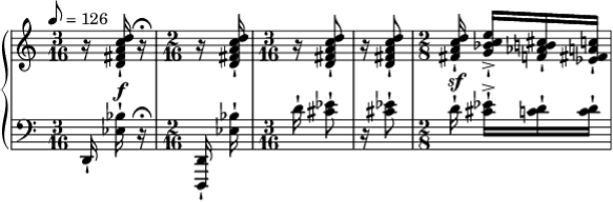
Here is the ‘Sacrificial Dance’ from the work – 3/16, 2/16, 3/16 2/8!
One of the joys of music is that regardless of levels of understanding or ability to explain it, you can hear it, feel it, perform it, listen to it and love it. Music is ‘for everyone’.
Interested in joining the choir? Click here
Become a Friend of NCS Click here